
GHK-Cu (Copper Peptide): A Research Overview
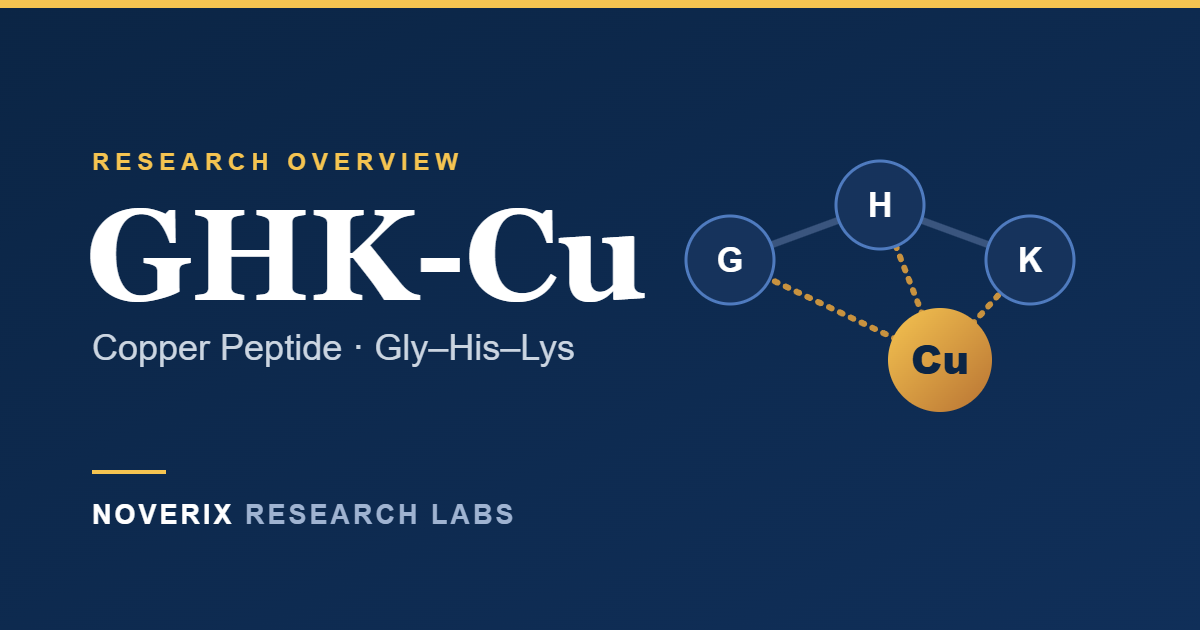
GHK-Cu — the tripeptide glycyl-L-histidyl-L-lysine bound to copper(II) — is one of the most extensively studied copper-binding peptides in the research literature. First identified in human plasma more than fifty years ago, it has become a reference compound for investigators examining the extracellular matrix, tissue-remodeling pathways, and copper transport. This overview summarizes what GHK-Cu is, where it came from, and the areas in which it is most commonly studied, strictly in the context of laboratory and preclinical research.
What Is GHK-Cu?
GHK is a naturally occurring tripeptide with the amino-acid sequence glycine–histidine–lysine (Gly-His-Lys). Its defining feature is a high affinity for copper(II) ions: the histidine and lysine residues form a stable coordination complex with copper, producing the blue-tinted molecule referred to as GHK-Cu. In human plasma the concentration of GHK is highest in early adulthood and declines with age, an observation that first drew researchers’ attention to its possible signaling roles. Because the copper is an integral part of the molecule, identity testing for GHK-Cu involves confirming both the peptide sequence and the bound copper content.
Discovery and Background
GHK was first isolated in 1973 by Loren Pickart, who observed that a factor present in human albumin from younger donors influenced liver-tissue cultures differently than albumin from older donors. The active factor was identified as the GHK tripeptide. Later work established that GHK readily binds copper and that the copper complex, rather than the free peptide, accounts for much of the activity reported in cell-culture systems. Five decades of laboratory study have accumulated around the molecule since then.
Areas of Research Interest
In research settings, GHK-Cu is studied across several overlapping areas:
- Extracellular matrix and collagen: in-vitro models examining how fibroblasts express collagen, elastin, and other matrix proteins.
- Tissue-remodeling and wound models: cell-culture and animal studies of repair-associated gene expression.
- Antioxidant and anti-inflammatory signaling: investigations of how the copper complex influences oxidative-stress markers in cultured cells.
- Gene-expression profiling: transcriptomic studies reporting that GHK can modulate the expression of large numbers of genes in cultured human cells.
These findings come from in-vitro and preclinical systems. GHK-Cu offered for research is intended for laboratory investigation only.
Handling and Reconstitution in the Laboratory
GHK-Cu is typically supplied as a lyophilized (freeze-dried) powder. For research use it is reconstituted with an appropriate solvent such as bacteriostatic or sterile water, kept cold, and protected from light and repeated freeze–thaw cycles to preserve the integrity of the copper complex. Because copper coordination can be sensitive to pH and oxidation, careful handling matters more here than it does for many simpler peptides. For general guidance on preparing and storing lyophilized peptides, see our note on reconstitution and storage.
Why Identity and Purity Matter
For a copper peptide, a Certificate of Analysis should confirm three things: the correct peptide sequence, the expected purity by HPLC, and the presence and amount of bound copper. Mass spectrometry confirms molecular identity, while HPLC quantifies purity and flags related impurities. If you want help interpreting a vendor’s documentation, our analysts review certificates through the Noverix Verify service, and our checklist on spotting a fake COA walks through the most common red flags.
Want the full scientific picture?
Download the Free Noverix Guide — 200+ pages on mechanisms, biological pathways, evidence levels, and laboratory quality.
Get the Free Noverix Guide →