Selank: A Synthetic Tuftsin-Analog Peptide in Neuropeptide Research
Selank is a synthetic peptide studied in neuropeptide research, best known as a stabilized analog of the immunomodulatory fragment tuftsin. It is one of a small group of peptides originally developed in Russian research programs and now widely discussed in the research-peptide community. As always, the framing matters: the material discussed here is research material for laboratory use only — not for human or veterinary use, and not a medicine.
What is selank?
Selank is a heptapeptide based on tuftsin, a naturally occurring immunopeptide, extended with a Pro-Gly-Pro sequence that improves stability against enzymatic breakdown. That stabilization is the whole point of the design — tuftsin itself is short-lived, and the added residues let researchers study the molecule over a usable timeframe without changing its core.
Proposed mechanisms under study
In research settings, selank has been examined in the context of GABAergic and monoaminergic signaling, expression of neurotrophic factors such as BDNF, and immune-modulating activity inherited from its tuftsin origin. These are areas of investigation, not settled conclusions: most of the work sits at the in-vitro and animal-model tiers, and the picture is still being assembled.
How the evidence is layered
Much of the published selank literature originates from Russian research groups, with limited large-scale independent clinical replication in the Western literature. That does not make the research uninteresting, but it does mean claims should be read with the evidence tier attached: mechanistic and animal-model findings are not the same as established human clinical outcomes, and research-grade material is not a therapeutic in any case.
Selank and semax
Selank is frequently discussed alongside semax, another short synthetic neuropeptide from the same research tradition. They are distinct molecules with different parent sequences — selank from tuftsin, semax from a fragment of ACTH — so despite often appearing together, a Certificate of Analysis for one says nothing about the other.
Identity and purity: reading the data
For any short synthetic peptide, two questions decide quality. Is it the right molecule? — identity by mass spectrometry (LC-MS). How pure is it? — by HPLC. A certificate can show one without the other, which is why understanding HPLC vs LC-MS: what each one proves and how to spot a fake peptide COA matters. The Free Noverix Guide covers this terminology in plain language.
Research use only
Selank research material is provided strictly for in-vitro and laboratory research. It is not a medicine, not a supplement, and not intended or authorized for human or veterinary use, nor to diagnose, treat, cure, or prevent any disease.
Semax: An ACTH(4–10) Analog in Neuropeptide Research
Semax is a short synthetic peptide studied in neuropeptide and neuroprotection research. It is derived from a fragment of adrenocorticotropic hormone (ACTH) but, by design, lacks the hormonal (corticotropic) activity of the parent molecule. Like several peptides in this library it comes from the Russian research tradition. The usual framing applies: the material discussed here is research material for laboratory use only — not for human or veterinary use, and not a medicine.
What is semax?
Semax is a heptapeptide based on the ACTH(4–10) fragment, extended with a Pro-Gly-Pro tail that improves stability. Crucially, the fragment it is built on does not carry ACTH’s hormone-releasing function, so semax is studied as a neuropeptide rather than as a hormonal agent — a good example of how a small sequence change separates two very different biological roles.
Proposed mechanisms under study
Research on semax has examined expression of neurotrophic factors such as BDNF and NGF, modulation of monoaminergic systems, and neuroprotective effects in cell and animal models. As with related peptides, these are active areas of investigation — mechanistic and preclinical findings that describe what is being studied, not confirmed human outcomes.
How the evidence is layered
The bulk of the semax literature comes from Russian research programs, with limited independent large-scale clinical replication elsewhere. Read each finding with its evidence tier attached, and remember that research-grade material is defined by its intended use — laboratory research — regardless of what any clinical literature reports.
Semax and selank
Semax is often mentioned in the same breath as selank. They share a research lineage and a Pro-Gly-Pro stabilization motif, but they are built on different parent sequences and are different molecules — so their analytical data are not interchangeable.
Identity and purity: reading the data
Two independent checks govern quality for any synthetic peptide: identity (is it the right molecule?) by mass spectrometry, and purity (how much is the intended compound?) by HPLC. A Certificate of Analysis can show one without the other. See HPLC vs LC-MS: what each one proves and how to spot a fake peptide COA, and the Free Noverix Guide for the terminology in plain language.
Research use only
Semax research material is provided strictly for in-vitro and laboratory research. It is not a medicine, not a supplement, and not intended or authorized for human or veterinary use, nor to diagnose, treat, cure, or prevent any disease.
Tesamorelin: A GHRH Analog in Growth-Hormone Axis Research
Tesamorelin is a synthetic analog of growth-hormone-releasing hormone (GHRH) that is widely studied as a tool for probing the growth-hormone axis. As with several peptides in this library, a note of precision matters first: an approved pharmaceutical form of tesamorelin exists as a prescription medicine, while the material discussed here is research material for laboratory use only — not for human or veterinary use. This overview is educational: what tesamorelin is, how GHRH signaling works, how it differs from a growth-hormone-secretagogue approach, and the analytical markers that separate trustworthy research material from questionable material.
What is tesamorelin?
Tesamorelin is a stabilized analog of human GHRH(1–44). Native GHRH is degraded quickly in circulation; tesamorelin carries a trans-3-hexenoic acid group at the N-terminus that improves stability while preserving affinity for the GHRH receptor. The design goal is familiar across peptide science — take an endogenous signaling molecule with a short half-life and modify it so it can be studied over a meaningful window without altering the receptor it targets.
How GHRH signaling works
GHRH acts on receptors expressed by somatotroph cells in the anterior pituitary. Receptor activation is associated with the pulsatile release of growth hormone (GH), which in turn influences the downstream IGF-1 axis. Because tesamorelin works upstream — prompting the pituitary rather than supplying GH directly — it is often studied as a way to examine endogenous, feedback-regulated GH release rather than exogenous hormone administration.
Tesamorelin vs the CJC-1295 / Ipamorelin approach
Tesamorelin is a GHRH analog: it mimics the natural releasing hormone. That is a different strategy from pairing a GHRH-type peptide with a growth-hormone secretagogue, as discussed in our overview of CJC-1295 and Ipamorelin, where two mechanisms are combined. The distinction is mechanistic and analytical at once: these are different molecules with different sequences and masses, so a Certificate of Analysis for one tells you nothing about another.
How the evidence is layered
Keep the tiers separate. Mechanistic and in-vitro work establishes GHRH-receptor activity; animal models explore physiological effects; and human clinical evidence exists for the approved, regulated pharmaceutical form — not for research-grade material. A result demonstrated for an approved drug in a supervised trial is not a property that transfers to unregulated research material, which is defined by its intended use.
Identity and purity: reading the data
Two independent questions govern quality. Is it the right molecule? — identity, confirmed by mass spectrometry (LC-MS). How much of the sample is the intended compound? — purity, measured by HPLC. A certificate can show one without the other. If these documents are new to you, start with HPLC vs LC-MS: what each one proves and how to spot a fake peptide COA. For the underlying terminology and quality markers in plain language, the Free Noverix Guide is the best starting point.
Research use only
Tesamorelin research material is provided strictly for in-vitro and laboratory research. It is not a medicine, not a supplement, and not intended or authorized for human or veterinary use, nor to diagnose, treat, cure, or prevent any disease.
GHK-Cu (Copper Peptide): A Research Overview
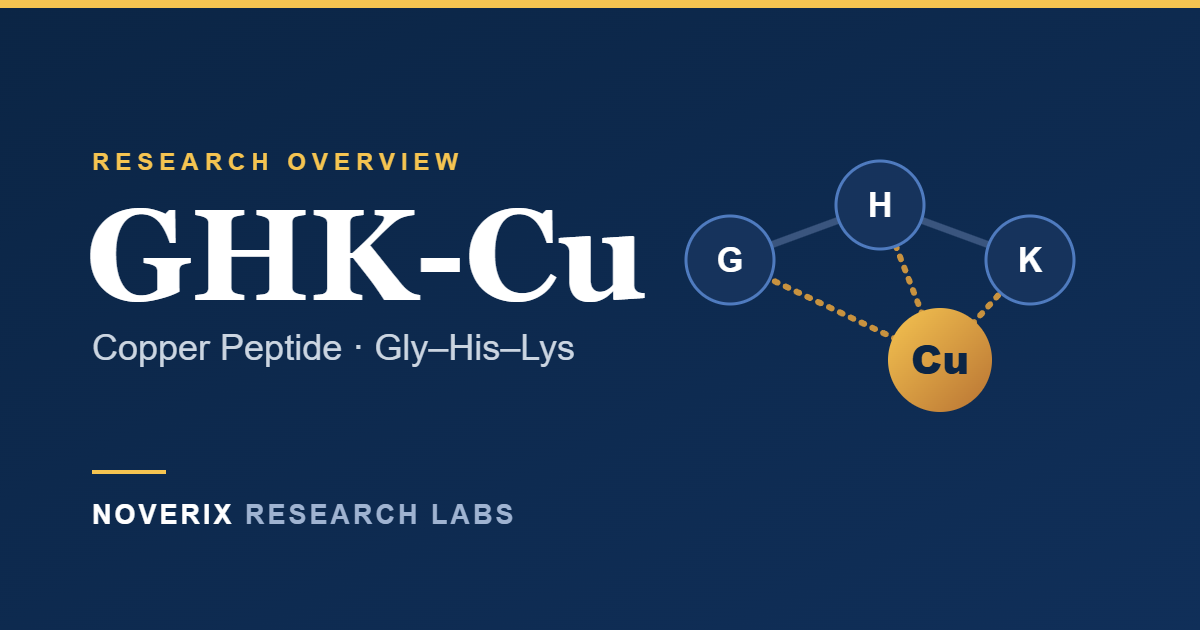
GHK-Cu — the tripeptide glycyl-L-histidyl-L-lysine bound to copper(II) — is one of the most extensively studied copper-binding peptides in the research literature. First identified in human plasma more than fifty years ago, it has become a reference compound for investigators examining the extracellular matrix, tissue-remodeling pathways, and copper transport. This overview summarizes what GHK-Cu is, where it came from, and the areas in which it is most commonly studied, strictly in the context of laboratory and preclinical research.
What Is GHK-Cu?
GHK is a naturally occurring tripeptide with the amino-acid sequence glycine–histidine–lysine (Gly-His-Lys). Its defining feature is a high affinity for copper(II) ions: the histidine and lysine residues form a stable coordination complex with copper, producing the blue-tinted molecule referred to as GHK-Cu. In human plasma the concentration of GHK is highest in early adulthood and declines with age, an observation that first drew researchers’ attention to its possible signaling roles. Because the copper is an integral part of the molecule, identity testing for GHK-Cu involves confirming both the peptide sequence and the bound copper content.
Discovery and Background
GHK was first isolated in 1973 by Loren Pickart, who observed that a factor present in human albumin from younger donors influenced liver-tissue cultures differently than albumin from older donors. The active factor was identified as the GHK tripeptide. Later work established that GHK readily binds copper and that the copper complex, rather than the free peptide, accounts for much of the activity reported in cell-culture systems. Five decades of laboratory study have accumulated around the molecule since then.
Areas of Research Interest
In research settings, GHK-Cu is studied across several overlapping areas:
- Extracellular matrix and collagen: in-vitro models examining how fibroblasts express collagen, elastin, and other matrix proteins.
- Tissue-remodeling and wound models: cell-culture and animal studies of repair-associated gene expression.
- Antioxidant and anti-inflammatory signaling: investigations of how the copper complex influences oxidative-stress markers in cultured cells.
- Gene-expression profiling: transcriptomic studies reporting that GHK can modulate the expression of large numbers of genes in cultured human cells.
These findings come from in-vitro and preclinical systems. GHK-Cu offered for research is intended for laboratory investigation only.
Handling and Reconstitution in the Laboratory
GHK-Cu is typically supplied as a lyophilized (freeze-dried) powder. For research use it is reconstituted with an appropriate solvent such as bacteriostatic or sterile water, kept cold, and protected from light and repeated freeze–thaw cycles to preserve the integrity of the copper complex. Because copper coordination can be sensitive to pH and oxidation, careful handling matters more here than it does for many simpler peptides. For general guidance on preparing and storing lyophilized peptides, see our note on reconstitution and storage.
Why Identity and Purity Matter
For a copper peptide, a Certificate of Analysis should confirm three things: the correct peptide sequence, the expected purity by HPLC, and the presence and amount of bound copper. Mass spectrometry confirms molecular identity, while HPLC quantifies purity and flags related impurities. If you want help interpreting a vendor’s documentation, our analysts review certificates through the Noverix Verify service, and our checklist on spotting a fake COA walks through the most common red flags.
Retatrutide: Triple GIP/GLP-1/Glucagon Agonist in Research

Retatrutide (research designation NVRX-RT3, also known in the literature as LY3437943) is a synthetic, single-molecule peptide that has become one of the most-studied compounds in metabolic-signaling research. Its defining feature is unusual: it acts as a triple agonist, engaging three different receptors — GLP-1, GIP, and glucagon — with a single molecule.
One molecule, three receptors
Most incretin-related research peptides target a single receptor. Retatrutide was engineered to bind and activate three at once:
- GLP-1 receptor — central to incretin signaling and glucose-dependent insulin research.
- GIP receptor — the second major incretin pathway, frequently studied alongside GLP-1 in metabolic models.
- Glucagon receptor — associated in research with hepatic glucose handling and energy expenditure.
Combining all three activities in one sequence makes retatrutide a uniquely efficient laboratory tool: instead of dosing three separate compounds, a research group can probe three interconnected pathways with one well-characterized peptide.
Why the triple-agonist design matters
The three receptors retatrutide targets sit at overlapping nodes of metabolic regulation. Studying them in isolation can miss the cross-talk between pathways. A single triple agonist lets researchers observe how simultaneous receptor engagement behaves in a controlled system — useful for receptor-pharmacology, signal-transduction, and structure-activity work. This is why retatrutide is often used as a reference compound when characterizing new incretin-class molecules.
Areas of research interest
- GLP-1, GIP, and glucagon receptor pharmacology and binding studies
- Incretin signaling and glucose-homeostasis models
- Energy-expenditure and metabolic-rate research
- Comparative studies against single- and dual-agonist peptides (e.g. tirzepatide)
These are areas of laboratory investigation only. Nothing here describes or implies any human, clinical, or therapeutic use.
Reference properties
- CAS: 2381089-83-2
- Molecular formula: C221H342N46O68
- Molecular weight: ~4731.4 g/mol
- Class: GLP-1 / GIP / glucagon triple receptor agonist
- Form: lyophilized powder, ≥99% purity (HPLC)
Handling, reconstitution & storage
Retatrutide ships as a lyophilized (freeze-dried) powder. Store the sealed vial at −20 °C for long-term stability. Reconstitute with bacteriostatic water; once in solution, keep refrigerated at 2–8 °C, protect from light, and avoid repeated freeze–thaw cycles, which degrade peptide integrity. For a deeper walkthrough, see our guide on reconstitution & storage.
Identity and purity: why the COA matters
A triple agonist is only as useful as its documented identity and purity. Every research lot should be accompanied by a Certificate of Analysis (COA) confirming identity by mass spectrometry and purity by HPLC. If you are not sure how to read one, our COA checklist breaks down what to look for — and Noverix Verify lets our scientists review a COA for you.

Melanotan II and the Melanocortin System: A Research Overview
Melanotan II is a synthetic research peptide studied for its interaction with the melanocortin receptor system. It is a structural analog of a naturally occurring signaling molecule and has been used in laboratory research on pigmentation biology and melanocortin signaling. This article covers what Melanotan II is, the receptors it engages, the evidence context, and the strict research-use framing that applies.
What Is Melanotan II?
Melanotan II is a synthetic analog related to alpha-melanocyte-stimulating hormone (α-MSH). It is classified as a research compound. It is not an approved drug, cosmetic, supplement, or therapeutic product, and it is not intended or authorized for human or veterinary use under any circumstances.
The Melanocortin Receptor System
- MC1R is central to research on melanogenesis — the biology of pigment production in melanocytes.
- MC3R / MC4R are studied in models for their roles in energy balance and central signaling.
- Broad activity: as a non-selective analog, Melanotan II is studied for engaging multiple melanocortin receptors, which is why its biology is examined carefully in controlled research settings.
Evidence & Research Context
Research on Melanotan II is preclinical in nature, and it carries no regulatory approval for any use. It is important to separate laboratory observations from claims about effects in people, which are not supported and are outside the scope of any legitimate research-use product.
Why Material Quality Matters
Accurate melanocortin research depends on confirmed peptide identity and content, documented by a verifiable COA. Related research material: Melanotan II (for research use only).
NAD+ in Cellular Metabolism: A Research Overview
NAD+ (nicotinamide adenine dinucleotide) is not a peptide but a coenzyme central to cellular energy and signaling, and it is widely studied in metabolism and aging research. Because it participates in hundreds of reactions, NAD+ has become a major focus of laboratory work on mitochondrial function and cellular maintenance. This article reviews what NAD+ is, its biological roles, the research landscape, and the role of material quality.
What Is NAD+?
NAD+ is a coenzyme found in all living cells. It exists in oxidized (NAD+) and reduced (NADH) forms and shuttles electrons in the reactions that generate cellular energy. Beyond energy metabolism, it is a substrate for several important enzyme families. NAD+ research material is intended for laboratory use only; it is not an approved drug, supplement, or therapeutic product for human or veterinary use.
Biological Roles Studied in Research
- Redox metabolism. NAD+/NADH cycling is fundamental to ATP production in mitochondria.
- Sirtuins. NAD+ is required by sirtuin enzymes, studied in the context of cellular stress and aging biology.
- PARPs. NAD+ is consumed by poly(ADP-ribose) polymerases involved in DNA-repair signaling.
- Cellular aging research. Declining NAD+ levels with age are an active area of preclinical investigation.
Evidence & Research Context
NAD+ biochemistry is well established, but research into NAD+ and related precursors as interventions is still evolving, much of it preclinical. As always, laboratory findings must be interpreted within their model and not extrapolated to human outcomes. Material sold by Noverix is for research use only.
Why Material Quality Matters
Reliable metabolic research depends on confirmed identity and content of the material used, documented by a verifiable COA. Related research material: NAD+ (for research use only).

MOTS-c: A Mitochondrial-Derived Peptide in Metabolic Research
MOTS-c is a research peptide of unusual origin: it is a mitochondrial-derived peptide (MDP), encoded within a short open reading frame in mitochondrial DNA rather than the nuclear genome. In cell and animal studies it has drawn attention for its association with cellular metabolism and stress response. This article reviews what MOTS-c is, its proposed mechanisms, the evidence landscape, and the role of material quality.
What Is MOTS-c?
MOTS-c (“mitochondrial open reading frame of the 12S rRNA type-c”) is a small peptide of about 16 amino acids. Its mitochondrial origin makes it part of a broader research interest in signals that travel between mitochondria and the rest of the cell. It is not an approved drug, supplement, or therapeutic product, and it is not intended for human or veterinary use.
Proposed Mechanisms of Action
- AMPK pathway. Research associates MOTS-c with AMP-activated protein kinase, a central regulator of cellular energy balance.
- Metabolic flexibility. Studies have examined its possible influence on how cells handle glucose and metabolic stress.
- Nuclear translocation. Under certain stress conditions in models, MOTS-c has been reported to move to the nucleus and interact with stress-response gene programs.
- Exercise and metabolism. Animal research has explored connections between MOTS-c and exercise-related metabolic adaptation.
These mechanisms come largely from cell and animal models and should not be read as established human effects.
What the Research Shows
The MOTS-c evidence base is primarily preclinical, with robust human clinical data limited and no regulatory approval. It remains an experimental research compound studied for its biology rather than any demonstrated outcome in people.
Why Material Quality Matters
As with any research peptide, a verifiable Certificate of Analysis (COA) confirming identity and content is essential to valid experiments. Related research material: MOTS-c (for research use only).

Tirzepatide: The Dual GIP/GLP-1 Receptor Agonist in Research
Tirzepatide is a peptide studied as a dual agonist of two incretin receptors — GIP and GLP-1. It has become a major focus in metabolic research because activating both pathways simultaneously is mechanistically distinct from targeting either one alone. This article explains what tirzepatide is, how the dual mechanism is described in the literature, the evidence landscape, and the importance of analytical quality.
What Is Tirzepatide?
Tirzepatide is an engineered peptide designed to engage both the glucose-dependent insulinotropic polypeptide (GIP) receptor and the glucagon-like peptide-1 (GLP-1) receptor. A pharmaceutical form of tirzepatide has received regulatory approval for specific clinical indications under medical supervision; however, research-grade material sold for laboratory use is not a medicine and is not intended for human or veterinary use.
The Dual Incretin Mechanism
The incretin system helps the body respond to nutrients after a meal. In the literature:
- GLP-1 receptor activation is associated with glucose-dependent insulin secretion, reduced glucagon when glucose is high, slowed gastric emptying, and central signals related to appetite.
- GIP receptor activation interacts with insulin secretion and adipocyte/energy metabolism in ways that are context-dependent.
- The combination is studied as an integrated intervention — not simply the sum of two separate hormones.
Both receptors belong to the G-protein-coupled receptor family and can increase intracellular cyclic AMP signaling on activation.
Evidence & Research Context
Tirzepatide is among the better-characterized peptides in this class, but research-grade study still requires careful separation of in-vitro, animal, and clinical evidence, and attention to the model and endpoints used. Material sold by Noverix is for in-vitro and laboratory research only.
Why Material Quality Matters
For metabolic peptide research, identity and net content must be confirmed — not assumed from a single purity figure. A verifiable COA is essential. Related research material: Noverix-TRZ (Tirzepatide) (for research use only).

CJC-1295 & Ipamorelin: The Growth-Hormone Axis in Research
CJC-1295 and Ipamorelin are two research peptides frequently studied together because they act on different parts of the same growth-hormone (GH) signaling axis. This article describes what each peptide is, why they are paired in research, the mechanisms involved, and the role of laboratory quality.
What Are CJC-1295 and Ipamorelin?
CJC-1295 is studied as an analog of growth-hormone-releasing hormone (GHRH). Ipamorelin is a selective growth-hormone secretagogue that acts on the ghrelin/GH-secretagogue receptor. Neither is an approved drug, supplement, or therapeutic product; both are experimental research compounds not intended for human or veterinary use.
Two Complementary Mechanisms
- GHRH pathway (CJC-1295): studied for its association with the signal that prompts the pituitary to release growth hormone.
- Ghrelin-receptor pathway (Ipamorelin): a separate receptor route also linked to GH release, noted in research for its selectivity.
- Why paired: acting on two distinct receptors is studied as a way to explore the pulsatile nature of GH signaling in models, rather than a single-pathway stimulus.
Evidence & Research Context
As with most research peptides, the available data lean preclinical, and human clinical evidence is limited. The popularity of GH-axis peptides in fitness and longevity circles often outpaces the robust evidence — a distinction serious research must preserve. These materials are for laboratory research only.
Why Material Quality Matters
Multi-peptide research is especially sensitive to identity and content errors. A verifiable COA confirming each component is essential. Related research material: CJC-1295 + Ipamorelin (for research use only).